Case study, wastewater treatment
Wastewater ozone nanobubble treatment, UniSA
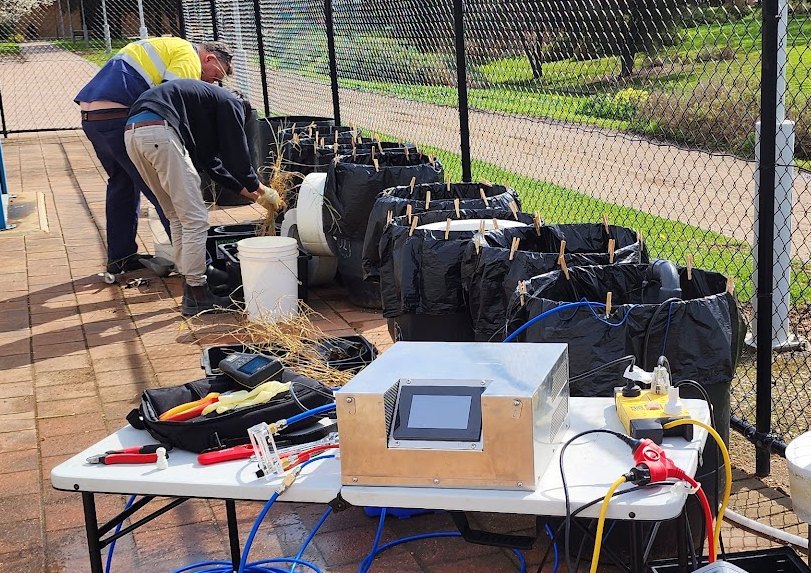
Hydro2050 partnered with UniSA to test a hybrid wastewater treatment approach combining ozone nanobubbles with constructed floating wetlands.
What the UniSA wastewater study found
What was tested
The study was designed to determine whether combining the strong oxidation capability of ozone with biological treatment from plants could provide a more effective, sustainable treatment system for wastewater, particularly for regional and rural communities.
Nanobubbles increase gas to water contact and can improve ozone transfer and oxidation efficiency. Ozone is a powerful oxidising agent capable of breaking down organic contaminants, while the nanobubble system also contributes to dissolved oxygen conditions within the water.
The results
The central finding was that the combined ozone nanobubble and constructed floating wetland treatment generally performed better than the individual treatment approaches. Ozone nanobubbles provide strong oxidation of contaminants, while the floating wetland plants and associated biological processes assist with nutrient uptake and transformation. The authors therefore see the two technologies as complementary rather than competing treatment mechanisms.
The study reports particularly strong performance for nutrient removal. The abstract states that the combined system achieved substantial reductions in total nitrogen, around 70%, total phosphorus, around 86%, and BOD, around 100%. Ozone alone showed more limited effectiveness for nutrient removal, whereas the constructed floating wetlands performed well in reducing nutrients and controlling E. coli.
The combined system, as reported in the abstract
70%
Reduction in total nitrogen, approximately
86%
Reduction in total phosphorus, approximately
100%
Reduction in BOD, approximately
Ozone treatment did not prevent plant growth. There was steady growth under all treatments, but plants receiving ozone had somewhat lower combined shoot length and shoot numbers than plants alone. This indicates that the plants were able to tolerate the ozone treatment, but there may be a trade-off between aggressive oxidation and maximum plant productivity.
The impact
The significance of the research is the demonstration that advanced oxidation and biological treatment can be integrated into a single treatment system. Rather than relying solely on chemical oxidation or solely on plants and microbial processes, the hybrid approach uses ozone to rapidly oxidise contaminants while the constructed wetland provides longer-term biological nutrient removal.
The authors see particular potential for regional wastewater treatment and water reuse, where conventional treatment infrastructure can be expensive or difficult to operate. The system is presented as potentially lower-cost, environmentally sustainable and adaptable for agricultural and horticultural applications where treated wastewater could become a reusable water resource.
Wastewater treatment
Two treatment methods that turn out to be complementary.
The second UniSA study on this site looks at ozone nanobubbles for algae and PFAS.